BTC Casino Fees and Processing, Taken Apart
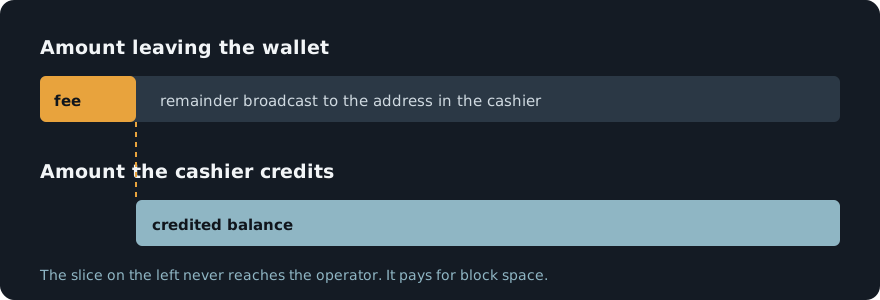
A single Bitcoin transfer into a casino account can meet three separate charges from three different parties, and only one of them belongs to the chain. This note separates them, explains how to recognise each by the way it behaves, and then deals with the part of the delay that no charge affects at all.
Nothing in this note is attributed to an operator. The subject is the coin and the tooling around it, which is the part that can be stated without a source inside somebody's account.

Three charges, told apart by behaviour
The network fee is a bid for room in a block. It goes to whoever assembles that block, it is set by whoever signs the transfer, and it moves continuously because the queue it is bidding against moves continuously. A figure that was generous this morning can be thin this afternoon.
A sending platform's price is revenue. A custodial service releasing coins charges what its pricing document says, that document changes rarely, and the figure therefore sits still for months at a time. If a charge has not moved in weeks, it is this one.
A cashier charge is the third, where the operator sets one on this route, and many crypto cashiers set none. It is the only one of the three that the receiving side controls, which is why it is also the only one worth complaining to them about.
Why the price of block space moves at all
Blocks hold a limited quantity of data and arrive on an average schedule. Every pending instruction is competing for part of that room, so the ones included are the ones that offered most, and the price is whatever the marginal instruction paid.
Because the unit sold is data, the sum being moved is close to irrelevant. What raises the size of an instruction is the number of earlier arrivals it spends: one arrival makes a small instruction, a dozen makes a large one, and the large one pays more for the same place in the queue.
That has a consequence most readers meet only once: a balance built from many small deposits costs more to send out again than the same total that arrived in one piece.
Processing: what a fee buys and where it stops
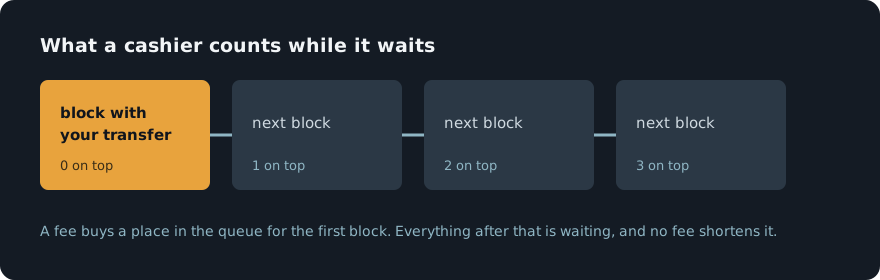
A generous bid improves the odds of inclusion in the next block. It has no effect whatever on the blocks after that. A cashier waiting for three confirmations is waiting for three blocks to exist, and the payment attached to the instruction is already spent and irrelevant.
This is the single most useful distinction on the subject. A reader who pays the top preset and then watches a balance sit for half an hour has not been short-changed and nothing has failed; they have bought priority in a queue, and the queue ended when the instruction was included.
It also means a cashier stating a confirmation count is telling you something it controls, while a cashier promising a crediting time is promising something it does not.
When a charge is worth questioning
When the gap between what left the sending account and what was credited is several times the figure the wallet quoted. That points at the sending platform, not at the cashier, and the place to look is the release confirmation on the platform's own screen.
When a charge quoted as a percentage appears on a Bitcoin transfer. The chain never charges a percentage of the sum, so a percentage is somebody's commercial decision and belongs to whoever displayed it.
When a cashier charge appears that was not shown before the transfer. That one is answerable by the operator, and it is the only one of the three that is.
Other cashiers read the same way

Rollbit
A transfer sent too cheaply sits unconfirmed, and the way out is a replacement, not a retry.

Roobet
A balance built from many small arrivals costs more to move out than one large arrival.

Sportsbet.io
The operator counts its deposit minimum after the network fee, so a transfer at the floor can arrive below it.
Questions about which charge is which
- How do I recognise the network fee?
- By movement. It changes through the day because it bids against a queue, while a platform's own price sits still until a pricing document changes.
- Can I avoid all three charges?
- No. Holding your own keys removes the sending platform's price; room in a block still has to be paid for by whoever signs the transfer.
- Why would a payout cost more than a deposit?
- Because the instruction may spend many earlier arrivals, which makes it larger in data terms, and room in a block is sold by data rather than by value.
- Does a higher fee shorten the whole wait?
- Only the first part. Confirmations after inclusion are blocks being produced, and the payment attached to the instruction is already spent.