BTC at Roobet: Many Small Arrivals, One Expensive Exit
This is a note about the cashier, not the catalogue: how Bitcoin arrives in an account, what it costs to move it out again, and why the second figure depends on the shape of the first. A reader planning a payout will find the relevant mechanism here.
The facet worked through on this page is a counter-intuitive one. A balance built up from a dozen small arrivals is physically more expensive to send out than the same total that arrived once, because the instruction that spends a dozen arrivals is a larger instruction.

Why the shape of a balance has a price
A Bitcoin instruction has to name the earlier arrivals it is spending. Spending one arrival names one; spending twelve names twelve. The second instruction is several times the size of the first in data terms, and room in a block is sold by data.
So the same sum can cost noticeably more to move depending on how it got there. This is invisible inside an account, where a balance is just a number, and it becomes visible on the way out.
The effect is the mirror image of the one on the way in: several small deposits each pay their own fee, and then the balance they built pays again, more, when it leaves.
What a payout request can and cannot control
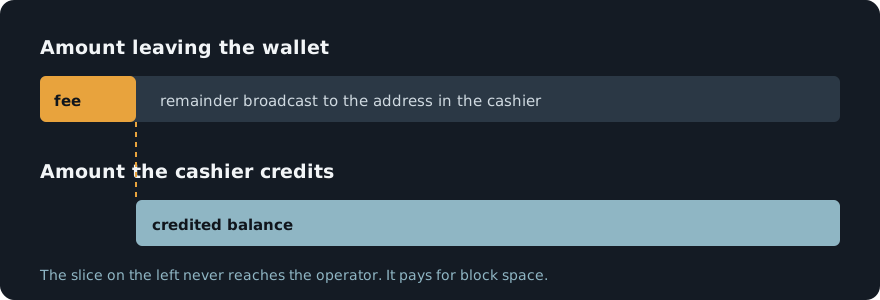
The sending side on a payout is the operator, so it attaches the payment and it decides whether that payment comes out of the requested sum or sits beside it. Those two conventions produce different numbers in your wallet for the same request, and only the payout screen can say which applies.
What a request cannot control is the chain's price at the moment it is broadcast. A payout approved during a busy period costs more to send than the same payout an hour later, and neither side chose that.
A reader who wants predictability has one lever: fewer, larger movements rather than many small ones. It is a blunt lever and it is the only one on this side of the screen.
Reading a payout record afterwards
Three figures make a payout auditable: the sum requested, the sum sent to the chain, and the sum that landed. Where all three are visible, any gap explains itself; where only the first is visible, a reader is left guessing.
Keep the reference until the receiving wallet shows the arrival as settled. A request marked complete on one side and absent on the other is almost always a wait rather than a loss, and the reference is what distinguishes the two.
If a payout has been sent and is not yet visible, the thing to count is confirmations. Until the first one, the instruction is still in the queue.
What Roobet's deposit guide says about Bitcoin
Roobet's help article on depositing with cryptocurrency names Bitcoin first among the coins it supports, and it gives a count in its own words: the crypto arrives 'after the required confirmations have hit (1 confirmation for BTC/XRP, and 3 confirmations for ETH/LTC/USDT/USDC).' For Bitcoin, that is one confirmation.
The article also says plainly what nobody can do about the wait: confirmations are processed by the blockchain, Roobet cannot estimate how long they take, and there is nothing to do to speed the process up. That is the point made above about a fee and a wait, stated by an operator. A larger fee can buy a place in the first block; it cannot shorten what follows.
The article names no Bitcoin network and no fee, so none is attributed to Roobet. It warns that sending any coin outside its list means the coin is lost and the account is not credited. No minimum, limit, bonus or licence is stated for Roobet here.
Other cashiers read the same way

Sportsbet.io
The operator counts its deposit minimum after the network fee, so a transfer at the floor can arrive below it.

Stake
The sending side chooses the fee. A cashier can display it and cannot set it.

Vave
Once a transfer is in a block, waiting for more confirmations costs nothing and buys nothing.
Questions this page gets
- Why would a payout cost more than my deposit did?
- Because the instruction sending it may have to name many earlier arrivals, which makes it larger in data terms, and room in a block is sold by data.
- Can I ask for a cheaper payout?
- The price is set when the instruction is broadcast and the sending side attaches it. A request cannot choose the chain's price at that moment.
- Does the fee come out of my payout or get added to it?
- Either, depending on the operator's convention. The payout screen is the only place that answers it, and the two conventions give different results.
- My payout is sent but not visible. What now?
- Count confirmations against the transaction reference. Until the first one, the instruction is still waiting for room rather than lost.