BTC Casino Cashiers and the Fee Nobody Charges You
This site reads a casino account from one end only: the cashier. What address it generates, what a transfer costs to put there, how many confirmations pass before the balance is usable, and which two figures have to be compared afterwards. There is no score on any page here, no star, no ranking of operators, because nothing has been measured that would justify one.
The question it keeps coming back to is the fee a Bitcoin transfer pays for room in a block. It is the one cost on a crypto deposit that no operator sets, nobody refunds and almost every reader attributes to the wrong party, and it is the reason the number credited to an account is smaller than the number typed into a wallet.

Where the network fee is taken, and by whom
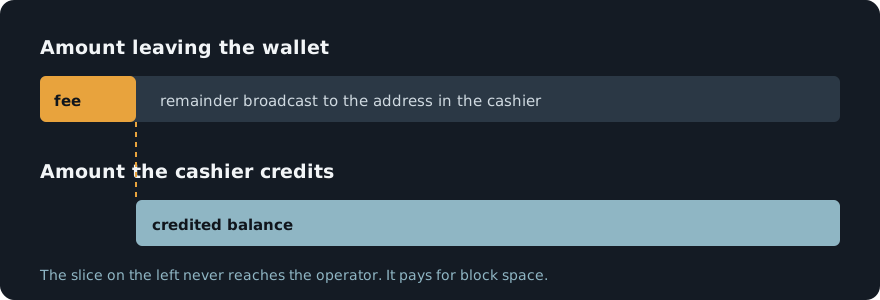
A Bitcoin transfer is not a message to a company. It is an instruction broadcast to a network, competing with every other pending instruction for a place in the next block, and the payment attached to it is what makes a block producer willing to include it. That payment is the network fee.
It is attached by whoever signs the transfer. On a deposit that is you, or the exchange releasing coins on your behalf. On a payout it is the operator. In neither case does the receiving side get to choose it, waive it, or hand it back, because it is spent before the instruction reaches anybody.
This single fact resolves most of the arguments readers have with support desks. A balance smaller than the amount sent is not a deduction by the casino; it is what was left after the chain was paid. The gap belongs to block space, and the only party who could have made it smaller is the one who pressed send.
Why the price of a transfer moves during the day
Room in a block is finite and sold by auction. When few instructions are pending, almost any payment is enough; when many are, the ones that get in are the ones that offered most. Nothing schedules this, so the price moves continuously and can double between deciding to send and actually sending.
What is being bought is data, not value. An instruction that spends one earlier arrival is small; one that spends a dozen is several times larger and pays accordingly, even if both move the same sum. It is why a transfer's cost tracks its shape rather than its size.
Two practical consequences follow. Several small deposits cost several times what one deposit of the same total costs, and a balance assembled from many small arrivals is more expensive to send out again. Neither is anybody's policy.
Twelve cashiers, and the same questions to ask each one
The twelve cards below are the twelve operators this site covers. They are listed alphabetically, which is a deliberately uninformative order: there is no rating behind the sequence, no card is recommended over another, and nothing on this site would support a sequence that meant anything.
Each card leads to a page that works through one facet of the same subject: how a cashier should present what a transfer costs, what it credits, and how long it waits. The facets differ so that twelve pages are twelve documents rather than one text with the names changed.
Four questions are worth asking at every one of them, and all four are answerable inside the cashier in a couple of minutes: what unit the balance is held in, what the minimum it credits automatically is, how many confirmations it waits for, and whether a payout fee comes out of the sum or sits beside it.
What these pages know about the operators, and what they do not
Where a statement about Bitcoin is made for an operator, it comes from that operator's own pages and says which kind of page it was. Stake, BitStarz, Cloudbet, Duelbits, Roobet, Rollbit, Sportsbet.io, BetFury and Vave each name the coin there; BC.GAME names it in its site description only. For FortuneJack nothing could be read, and CoinCasino's cashier could not be matched to the brand, so neither carries a statement.
Not found and not offered are different findings, and conflating them would be the more damaging of the two errors. Where a figure would have to come from an operator and none could be read, these pages leave the space empty rather than borrowing a number from a comparison table that may be two years old.
No bonus, wagering requirement, licence reference, deposit minimum or payout limit appears on any page here. None was ever part of what this site set out to say, and a convincing figure in place of a gap is a fabrication with a professional typeface.
Other cashiers read the same way

BC.GAME
Three separate charges can land on one deposit. Only one of them belongs to the chain.

BetFury
An exchange withdrawal charge and a network fee are different animals, and both can bite the same transfer.

BitStarz
Two Bitcoin lines on one payments page: the chain, and Lightning, which is settled another way.

Cloudbet
What the wallet quotes and what the cashier credits are two readings of the same transfer.

CoinCasino
On a payout the fee is either taken out of the sum or added beside it, and the difference is yours.

Duelbits
Economy, normal and priority are guesses about the next few blocks, not promises.

FortuneJack
A fixed charge hurts a small transfer and barely scratches a large one.

Rollbit
A transfer sent too cheaply sits unconfirmed, and the way out is a replacement, not a retry.

Roobet
A balance built from many small arrivals costs more to move out than one large arrival.

Sportsbet.io
The operator counts its deposit minimum after the network fee, so a transfer at the floor can arrive below it.

Stake
The sending side chooses the fee. A cashier can display it and cannot set it.

Vave
Once a transfer is in a block, waiting for more confirmations costs nothing and buys nothing.
Questions readers send about a crypto cashier
- Does the casino take a cut of my deposit?
- The gap between the amount sent and the amount credited is usually the network fee, which pays for room in a block and reaches no company. A cashier charge, where one exists, is shown separately.
- Why is the fee different every time?
- Because room in a block is auctioned. The price follows how many instructions are competing for the next blocks, and that number changes continuously through the day.
- Is it cheaper to deposit once or in several pieces?
- Once. Each transfer pays its own fee for block space, and that payment does not shrink in proportion to the amount being moved.
- Who is this site written for?
- Adults of 18 or older who already hold the coin and want the cashier arithmetic to be predictable. It takes no deposits and holds no accounts.