BTC Casino on a Phone: Where the Fee Control Hides
A deposit made from a phone goes through the same chain as one made from a desktop and pays the same kind of fee for the same room in a block. What differs is the screen: a mobile wallet has less room to show the figures, so it tends to collapse them, and the control that sets the fee is usually a tap further away than it is on a desktop.
This page is about that difference. It is a cashier page, not a review of an app, and it does not say which operator has one — no mobile product is attributed to any of the twelve here, because the material this site replaces described none.

What the hand-off between apps actually does
Tapping a deposit address on a phone commonly opens a wallet application with the destination and sometimes the amount already filled in. That is a convenience and it is also where a reader stops reading, because the fields look settled.
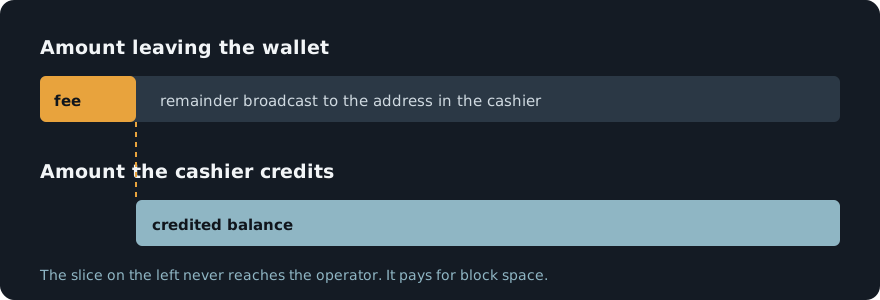
They are not all settled. The amount may be prefilled while the fee is left at whatever the wallet last used, and the two are presented with very different prominence. The figure worth finding is the total leaving the account, which on several interfaces appears only after expanding a summary.
Returning to the cashier afterwards does not change anything. Once the instruction is signed in the wallet it is on its way, and the cashier sees an arrival whose size was decided in the other application.
Performance and the parts worth not rushing
A deposit screen on a phone is a short form, and short forms invite speed. The two fields that punish speed are the destination and the fee: the first because an address shortened for display hides its middle, and the second because the default may be the wrong preset for a balance that is needed soon.
Shortened addresses are the specific trap. A wallet showing the first and last few characters is showing enough to recognise a correct paste and not enough to catch a wrong one, so the check that works is comparing against the cashier screen rather than against memory.
Where a wallet supports a scan instead of a paste, the scan removes the class of error entirely. It does not remove the fee question, which still has to be answered before signing.
Account continuity when the connection changes
Moving between a mobile network and a local one mid-session interrupts the page rather than the transfer. An instruction already broadcast carries on regardless; a cashier screen that was waiting for it may need reloading, and a reload is not a second deposit.
This is worth saying because the instinct at that moment is to send again. A second transfer is a second fee and, if both confirm, a second credit to unpick. The reference from the first one is the thing to consult instead.
A mobile cashier should expose the same balance, the same history and the same pending rows as the desktop one. Where it does, the interrupted session can be picked up and read; where it does not, the reference is the only record the reader has.
Two-factor protection on the account that holds the coin
The account worth protecting hardest is not the casino account; it is the wallet or exchange the coins live in. A compromised casino login costs a balance. A compromised wallet costs everything the wallet holds, and nothing about a Bitcoin transfer can be reversed afterwards.
So a second factor on the sending side is the higher-value control, and a recovery phrase belongs nowhere near a browser, a support conversation or a phone's photo library. No cashier ever needs it, and any request for one is a request to hand over the wallet.
A shared device and a public network add avoidable risk to both accounts. Neither is a reason not to deposit from a phone; both are a reason to do it on your own device.
Other cashiers read the same way

Roobet
A balance built from many small arrivals costs more to move out than one large arrival.

CoinCasino
On a payout the fee is either taken out of the sum or added beside it, and the difference is yours.

Duelbits
Economy, normal and priority are guesses about the next few blocks, not promises.
Questions about depositing from a phone
- Does a deposit from a phone cost more?
- No. The fee is set by the instruction and the queue, not by the device. What differs is where the wallet puts the control that chooses it.
- The hand-off filled everything in. Is the fee set too?
- Usually it keeps whatever the wallet last used. The figure to find before signing is the total leaving the account, which is often behind an expanded summary.
- My connection dropped mid-deposit. Should I send again?
- No. An instruction already broadcast carries on, and a second transfer pays a second fee. Consult the reference from the first one instead.
- Can a cashier ask for my recovery phrase?
- It never needs it, and any request for one is a request to hand over the wallet. A second factor on the sending account matters more than one on the casino login.