BTC at Duelbits: What the Fee Presets Really Promise
This note stays on the cashier: the fee a Bitcoin transfer pays, the wait before a balance moves, and the figures worth writing down on the way. It is not an assessment of the operator and contains no score.
Its subject is the row of buttons every sending wallet puts in front of you — slow, normal, fast, or words to that effect. They look like service levels and they are not. They are guesses about the next few blocks, and understanding what kind of guess they are changes how a reader uses them.

Estimates dressed as service levels
A wallet offering three speeds is reading the queue of pending instructions and proposing three payments: one likely to get in soon, one likely to get in eventually, and something in between. Nobody is promising anything, because nobody controls who assembles the next block or what they choose to include.
The estimates are usually good and occasionally wrong. If the queue grows sharply after an instruction is broadcast, the payment that looked generous becomes thin, and an instruction that was expected in the next block waits considerably longer.
That is the whole difference between this and a courier service. A courier accepts an obligation; a fee preset expresses a probability.
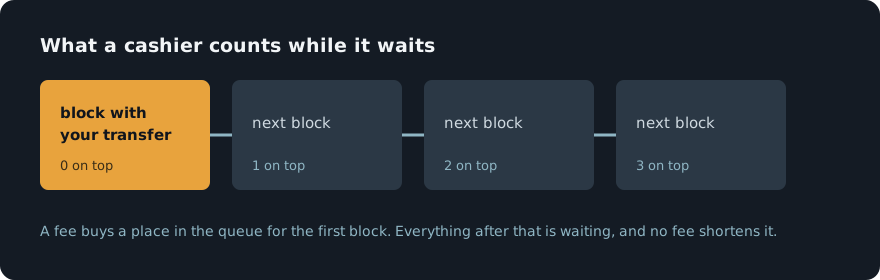
Choosing a preset for a deposit you need credited
If a balance has to be usable at a particular time, the cheap preset is the wrong instrument. The saving is small in absolute terms and the cost of being wrong is an hour or more of waiting with nothing to do about it.
If nothing depends on the timing, the cheap preset is almost always fine, and the difference between the two is often the least interesting number on the screen. The judgement is about the value of certainty, not about the size of the fee.
Either way, the number worth noting is the total leaving the account, because that is the figure the cashier's minimum has to be compared against.
When an instruction sits unconfirmed
An instruction with a thin payment is not lost and has not failed. It is in the queue, visible to anyone who looks it up, waiting for a block whose other contents are cheap enough that it gets in.
Some wallets can replace such an instruction with a better-paying version of itself. Where that option exists it is the correct move; where it does not, waiting is the only move, and sending a second transfer to the same address solves nothing and costs again.
Through all of this the cashier has nothing to act on, because nothing has arrived. A support request at this stage is premature and the answer will be the transaction reference you already have.
What Duelbits' help centre says about Bitcoin deposits
Duelbits' help article on depositing lists BTC first among the coins it takes and says the list is closed: only the coins listed are accepted, and sending other tokens may result in permanent loss. A second article carries a table of supported networks, and against Bitcoin (BTC) it prints one network, Bitcoin.
On timing the article is blunt. Deposits usually arrive within 5 minutes, it says, but may take longer during network congestion, and Duelbits cannot speed up blockchain confirmations. It adds that if fees are set too low, the transaction may take longer, which is the fee and the wait joined in one sentence by the operator.
The articles give no fee figure and no confirmation count for Bitcoin, so none is attributed to Duelbits. No bonus, licence, minimum or limit is stated for Duelbits on this page.
Other cashiers read the same way

FortuneJack
A fixed charge hurts a small transfer and barely scratches a large one.

Rollbit
A transfer sent too cheaply sits unconfirmed, and the way out is a replacement, not a retry.

Roobet
A balance built from many small arrivals costs more to move out than one large arrival.
Questions this page gets
- Is the fast preset a guarantee?
- No. It is the wallet's estimate of a payment likely to clear the current queue. Nobody controls which instructions the next block includes.
- My transfer is unconfirmed hours later. Is it lost?
- No. It is waiting in the queue and can be looked up by its reference. A thin payment delays an instruction rather than cancelling it.
- Should I send a second transfer?
- No. A second transfer pays a second fee and does not help the first. If the wallet can replace the original with a better-paying version, that is the move.
- Which preset should a deposit use?
- The cheap one when nothing depends on timing, and a higher one when it does. The saving is usually small next to the cost of waiting.