BTC at FortuneJack: Small Transfers Feel the Fee Most
This page is about receiving and sending, not about the lobby. It follows what a Bitcoin transfer costs, who that cost goes to, and what is left for the balance once it has been paid.
The specific issue here is proportion. Because the chain prices an instruction by its size rather than by its value, the same payment is a rounding error on a large transfer and a serious share of a small one, and that changes how a careful reader sizes a deposit.

Why proportion matters more than the figure
A payment for block space is quoted in the coin, and the coin does not know what the transfer is for. Moving a modest sum and moving a large one produce instructions of similar size, so they attract similar payments, and the smaller transfer surrenders a much larger share of itself.
This is the opposite of how card processing feels, where the cost scales with the amount. A reader carrying that expectation across will consistently underestimate what a small transfer costs and overestimate what a large one does.
The practical rule that follows is dull and effective: fewer, larger movements. Every additional transfer pays again, and the payment does not shrink to match the amount.
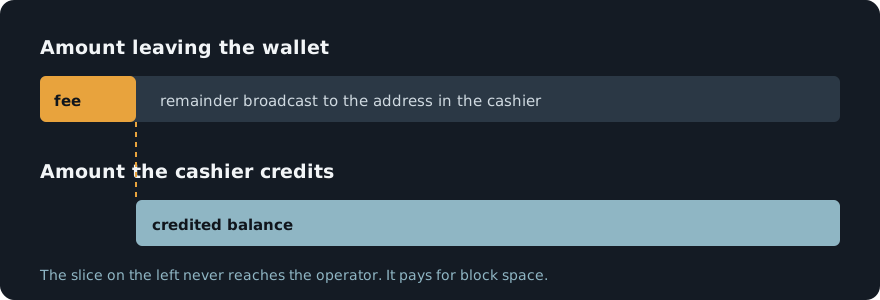
Sizing a deposit so it still credits
A cashier credits what arrives. If a minimum is stated and the amount after the payment lands beneath it, the arrival may sit outside the automatic rule, and resolving that takes a conversation rather than another transfer.
So the figure to compare against a minimum is not the one typed into the wallet. It is the one the wallet says will actually be delivered, which on some interfaces requires looking at a second line.
Where the margin is thin, adding a little to the transfer is cheaper than discovering the problem afterwards. The extra costs nothing to send; the problem costs time.
The part a fee does not pay for
Paying well buys a place in the next block and nothing beyond it. A cashier that waits for several confirmations is waiting for blocks to be produced, and that interval is indifferent to how much was paid.
This separation is worth internalising because it defuses the most common frustration: a generous payment followed by a balance that still has not moved. Nothing is wrong, and nobody is holding anything back.
The number of confirmations a cashier waits for is its own decision, and it is worth reading before a first transfer rather than while watching one.
Why nothing is said about FortuneJack's Bitcoin cashier
FortuneJack's own site refused an automated read: its pages answered with a block page, its help addresses answered from a protection service instead of a help centre, and its help subdomains do not resolve. No statement by the operator about Bitcoin could be read, so none is quoted.
Could not be read is not the same as does not accept. This page does not say that FortuneJack takes Bitcoin, and does not say that it does not. The first would be a fact about the operator and the second a fact about this page's sources; only the second is known.
The mechanics above are properties of the coin and hold wherever a transfer is sent. What this cashier supports, charges and shows is for its own screen to say.
Readers who want the operator's own word on Bitcoin have a plain route: open the cashier, pick the coin and read what it prints beside the address field. A network name, a minimum and a confirmation count shown there are the operator's statement, and they will be more current than anything a third-party page could copy.
Other cashiers read the same way

Rollbit
A transfer sent too cheaply sits unconfirmed, and the way out is a replacement, not a retry.

Roobet
A balance built from many small arrivals costs more to move out than one large arrival.

Sportsbet.io
The operator counts its deposit minimum after the network fee, so a transfer at the floor can arrive below it.
Questions this page gets
- Why does a small deposit lose so much to the fee?
- Because the payment is for the size of the instruction, not for the value. A small transfer produces a similar instruction and surrenders a larger share of itself.
- Is it cheaper to deposit once or several times?
- Once, almost always. Each transfer pays its own fee for block space, and that payment does not shrink in proportion to the amount.
- What if the amount after the fee falls under the minimum?
- A cashier credits what arrives, so the arrival may fall outside its automatic rule. Compare the minimum against the delivered figure, not the typed one.
- Does paying more shorten the wait?
- Only for the first block. Confirmations after that are blocks being produced, and no payment makes them arrive sooner.