BTC Casino Payments: the Fee, the Credit and the Gap
This is the cashier page, and it is about money moving rather than about which operator deserves it. It follows a Bitcoin amount from the moment it leaves a wallet to the moment a balance changes: what was paid on the way, who received that payment, and why the two figures at either end of the journey never match.
Everything here is a property of the coin, not of a company. Where an operator's own page says something about fees or waiting, the brand page quotes it and names the page; no operator is credited with a minimum or a limit. What can be stated with confidence is how the fee works, and that is enough to make a deposit predictable.

How Bitcoin casino deposits work
A deposit is a push, not a pull. No casino system reaches into a wallet; the holder signs an instruction and broadcasts it, and the cashier watches an address for an arrival. That is why there is no authorisation step, no decline, and no chargeback: nothing was ever requested from the other side.
Most cashiers generate a fresh address per session or per account. Reusing one found in an old message risks sending to an address that still belongs to the operator and no longer belongs to you, which produces a transfer that confirmed perfectly and credited nobody.
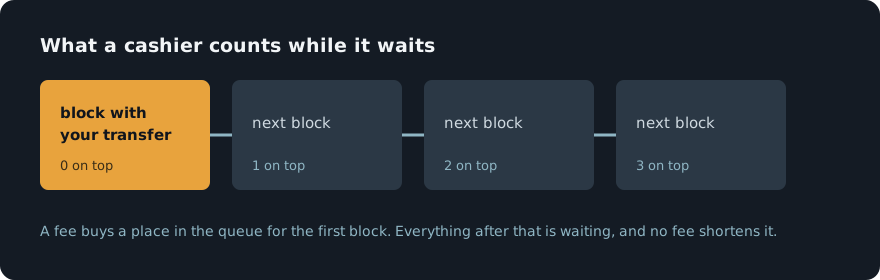
Once broadcast, the instruction waits for inclusion in a block and then for a number of blocks on top of it. The cashier credits when its own confirmation threshold is met, and that threshold is its decision rather than the chain's.
What is the bitcoin network fee
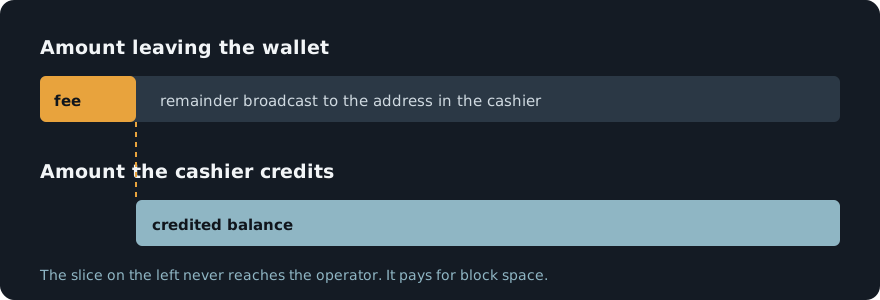
It is the payment attached to an instruction so that whoever assembles the next block has a reason to include it. Blocks hold a limited quantity of data, every pending instruction is bidding for part of that room, and the fee is the bid. It goes to the block producer and to nobody else.
Because it buys data rather than value, the sum being moved barely affects the price. A modest transfer and a large one produce instructions of similar size and attract similar payments, which means the smaller transfer surrenders a far larger share of itself.
And because the bidding is continuous, the figure moves. A payment that would have cleared the queue an hour ago may not clear it now, which is the whole explanation for a transfer sitting unconfirmed while a later one from someone else goes straight through.
Fees and minimum limits, in the order that matters
Three separate charges can land on one deposit and only one of them belongs to the chain. A custodial platform releasing coins sets its own price, which is revenue and sits still for months. The network fee is the bid for block space and moves within the hour. A cashier charge, where the operator sets one, is the third, and many crypto cashiers set none.
They are confused because only the last is ever named on the screen the player is looking at, and because the three are often quoted in three different units. The remedy is dull: note the figure at each step instead of at the end.
Then compare the delivered amount, not the typed amount, against the cashier's stated minimum. An arrival below that minimum can sit outside the automatic crediting rule, and resolving it takes a conversation rather than a second transfer.
Timeframes: the part the fee does not pay for
A generous bid improves the odds of inclusion in the next block. It does nothing about what comes after. A cashier waiting for three confirmations is waiting for three blocks to be produced, and no payment makes them arrive sooner.
Blocks also arrive at an average rate rather than a fixed one, so a quick run and a long gap are both ordinary. A cashier that promises an exact crediting time is promising something it does not control; one that states a confirmation count is describing its own policy, which is the more honest of the two.
Readers who need a balance at a particular moment should send earlier rather than paying more. The extra payment buys a place in a queue that may already be short, and it never buys the blocks that follow.
An invoice route is a different instrument
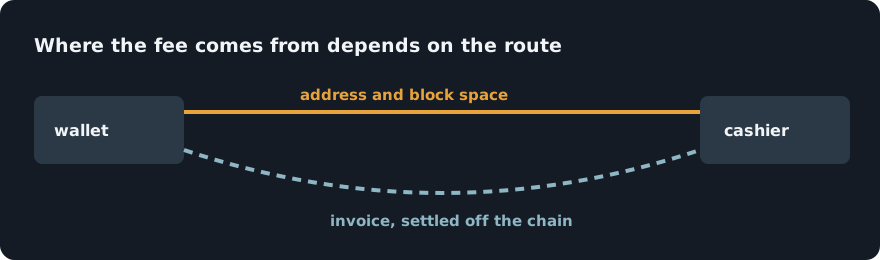
Bitcoin also reaches a cashier without a block being written for each payment. On that route the transfer is settled between channels, the cost structure is different in kind, and the wait is not a block count. It is the same coin on a different mechanism, and a figure quoted for one route says nothing about the other.
A wallet has to support the route the cashier is offering. An invoice pasted into a wallet that only understands addresses does nothing useful, and the two instruments look similar enough at a glance for the mistake to be easy.
Minimums usually differ between the routes as well, because the two mechanisms make different sums worth processing. Where a cashier offers both, read the figure next to the route rather than the figure at the top of the screen.
Payment records, and what makes one auditable
Four fields make a deposit record worth having: the amount credited, the unit it is held in, the time the record was created and its current state. With those, a reader can line the credited figure up against what left the sending account and see where the difference went.
Pending entries should stay visible instead of appearing only once everything worked. A history that is complete only in the happy case is a history that fails at the one moment anybody consults it.
On the reader's side the equivalent is the transaction reference. It records what was handed to the chain, which is a different question from what an operator received, and it is the only artefact that settles a disagreement between the two.
Other cashiers read the same way

Cloudbet
What the wallet quotes and what the cashier credits are two readings of the same transfer.

BC.GAME
Three separate charges can land on one deposit. Only one of them belongs to the chain.

BetFury
An exchange withdrawal charge and a network fee are different animals, and both can bite the same transfer.
What readers ask when the figures disagree
- Do you have to pay a fee to receive Bitcoin?
- No. Arrivals cost nothing. The gap readers notice is the payment the sender attached for block space, taken before the instruction reached the address.
- Can a cashier refund the network fee?
- No. It was spent on room in a block before the instruction arrived anywhere, so there is nothing for the operator to return.
- Why is my transfer still unconfirmed?
- Because the payment attached to it has not yet been attractive enough for a block. It is waiting in the queue, not lost, and a second transfer does not help it.
- Should the minimum be read before or after the fee?
- After. A cashier credits what arrives, so the delivered figure is the one its automatic rule applies to.