BTC at BC.GAME: Three Charges, One Deposit
This note stays on the cashier end of an account: how a Bitcoin amount is received, what it costs to put it there, and how long a balance takes to move. It is written for someone who has already decided to send something and wants the arithmetic to hold. There is no rating on this page and no comparison of lobbies.
The specific problem it works through is that one deposit can meet up to three separate charges, from three different parties, and only one of them is the chain's. Readers who treat them as a single mysterious deduction end up with a balance they cannot account for and a support conversation that goes nowhere.

Three charges, three different parties
The first charge appears when coins leave a custodial account. An exchange that sends Bitcoin on your behalf usually sets its own withdrawal price, and that price is the exchange's revenue, chosen by its commercial department rather than by the chain.
The second is the network fee proper: the payment attached to the instruction so that whoever assembles the next block has a reason to include it. It goes to the block producer and to nobody else.
The third is a platform charge, if the operator sets one on this payment route. Many crypto cashiers set none, which is why the first two are so often mistaken for it. A screen that labels all three separately is doing the reader a real service.
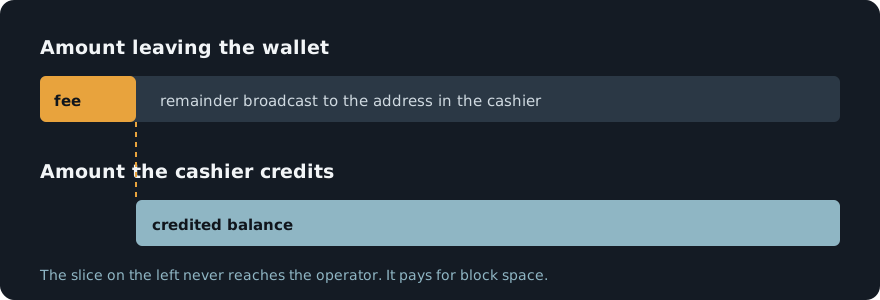
Why the three are so easily confused
They are confused because only the last of them is ever named on the screen a player is looking at. The sending platform's price appears on a different screen, in a different session, often several minutes earlier, and the network fee is frequently folded into the same line.
A second reason is the unit. One charge may be quoted in Bitcoin, another as a fiat equivalent, and the third as a percentage, so adding them up requires converting between three presentations of the same deduction.
The practical answer is to note the figure at each step rather than at the end. Two numbers written down in the sending account, before anything is signed, remove the entire mystery from the balance that appears later.
What the account history should let you reconstruct
A deposit record worth having names the amount credited, the unit it is held in, the time the record was created and the current state of the request. With those four, a reader can line the credited figure up against the figure that left the sending account and see exactly where the difference went.
Pending entries should stay visible rather than vanishing until they succeed. A record that only appears once everything worked is a record that is useless at the one moment anyone needs it.
If the two figures still do not reconcile, the transaction reference settles it. It shows what was actually handed to the chain, which is a different question from what the operator received.
How much of BC.GAME's cashier could be read
BC.GAME draws its pages with script, so its help and payment pages come back as an empty shell with no text to quote. The one sentence the operator publishes in plain markup is its site description, and that sentence lists BTC among the coins it supports.
It names the coin and nothing else: no network, no fee, no confirmation count and no crediting time. So this page treats Bitcoin as named by the operator and describes nothing about how its cashier handles it. The three charges above are properties of the coin and of exchanges; which of them a given deposit meets is what the cashier screen shows.
No bonus, licence, minimum or limit is stated for BC.GAME here, and an open-ended list in a site description says nothing about the coins it leaves out.
Other cashiers read the same way

BetFury
An exchange withdrawal charge and a network fee are different animals, and both can bite the same transfer.

BitStarz
Two Bitcoin lines on one payments page: the chain, and Lightning, which is settled another way.

Cloudbet
What the wallet quotes and what the cashier credits are two readings of the same transfer.
Questions this page gets
- Which of the three charges reaches the casino?
- At most the third, and only where the operator sets one. The first belongs to the platform the coins left and the second to whoever assembled the block.
- Can I avoid the sending platform's charge?
- Only by sending from a wallet you hold the keys to, which has no commercial price list. The network fee still applies, because it pays for room in a block.
- Why is one charge shown as a percentage?
- Because platforms price their own services however they like. The chain's fee is never a percentage of the sum; it follows the size of the instruction instead.
- Where do I see what was really sent?
- In the transaction reference the sending wallet produces. It records what was handed to the chain, independently of what any account screen says about it.