BTC at BetFury: Two Charges With One Name
The subject of this page is the cashier end of an account: how a Bitcoin amount is received, what the transfer costs, and when the balance becomes usable. It is not a verdict on the operator and it carries no score.
What it works through is the most common single misreading of a Bitcoin deposit. A charge set by the platform the coins are leaving and the fee paid for room in a block are two different things that often appear under one label, and treating them as one makes the arithmetic impossible.

What is a network fee, and what is not
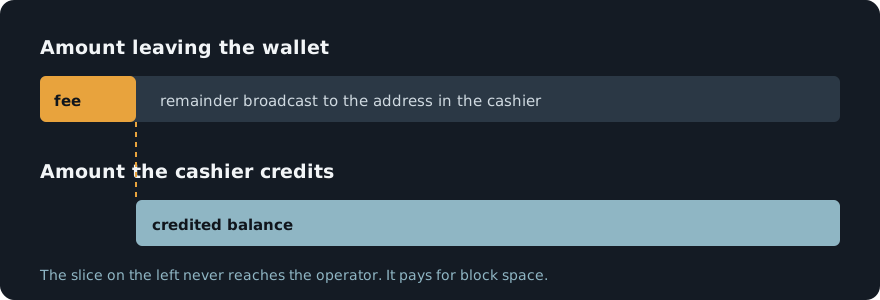
A network fee is the payment attached to an instruction so that whoever assembles the next block has a reason to include it. It is not revenue for any company. It exists because block space is finite and has to be allocated somehow.
A platform charge is revenue. When a custodial service releases coins on your behalf, it may price that service however it likes, and that price has no relationship to how busy the chain is on the day.
The two behave differently and that is how to tell them apart. A network fee moves with demand for block space and can change within the hour. A platform charge tends to sit still for months, because somebody set it in a pricing document.
Fees and limits, read in the right order
Read the sending side first. Whatever that screen says will leave the account is the real starting figure, and it may already include one or both charges depending on how the service presents them.
Read the cashier second, for the minimum it will credit without intervention. Comparing that minimum to the figure after deductions is the step most readers skip, and it is the step that decides whether a deposit credits itself or needs a conversation.
A limit quoted for one route does not transfer to another. A cashier may offer several payment routes with different minimums, and assuming one number covers them all produces a transfer that is technically fine and administratively stuck.
Sending from your own wallet changes one of the two
A wallet whose keys you hold has no commercial price list, so the platform charge disappears. What does not disappear is the network fee, because room in a block still has to be paid for by somebody and that somebody is the sender.
This is why the advice to move coins into a wallet first is not a way of avoiding fees. It removes one deduction and leaves the other, and it adds a transfer, which has its own cost.
Whether that trade is worth making depends entirely on the size and frequency of the transfers, and it is arithmetic a reader can do once and reuse.
What BetFury's documentation says about fees and Bitcoin
BetFury's documentation page on deposits and withdrawals says that any cryptocurrency transfer includes a commission and that the commission depends on the network or payment service chosen. Its worked example is Ethereum, where the same deposit costs very different amounts on two networks. A second example, buying a coin with a card, shows the fee shrinking as a share of a larger purchase.
Bitcoin is named by the operator: BTC leads the list of accepted currencies in the structured data on BetFury's own home page. The documentation names no Bitcoin network and no Bitcoin fee. The operator puts a number on waiting twice, and the two numbers are the same while the stages are not. Its documentation, about money coming in: “The deposit is credited automatically. If you do not receive your crypto instantly, don’t worry. In rare cases, the deposit may take 24-72 hours.” Its home page, about money going out: “our risk department conducts a manual audit of each transaction. Depending on the case, withdrawals can take up to 24-72 hours.” The matching figures invite reading them as one wait. They are not: a rare delay on the way in, and a queue inside the company on the way out.
Nothing from the Ethereum example is carried over to Bitcoin, and no bonus, licence, minimum or limit is stated for BetFury here.
Other cashiers read the same way

BitStarz
Two Bitcoin lines on one payments page: the chain, and Lightning, which is settled another way.

Cloudbet
What the wallet quotes and what the cashier credits are two readings of the same transfer.

CoinCasino
On a payout the fee is either taken out of the sum or added beside it, and the difference is yours.
Questions this page gets
- Is the network fee a casino charge?
- No. It pays for room in a block and goes to whoever assembles it. An operator cannot set it, waive it or refund it.
- How do I tell the two charges apart?
- By their behaviour. A network fee moves with demand for block space, sometimes within the hour. A platform charge sits still until a price list changes.
- Does using my own wallet remove both?
- It removes the platform charge, not the network fee. Room in a block still has to be paid for by whoever signs the transfer.
- Do all payment routes share one minimum?
- Not usually. A cashier may set a different minimum per route, and assuming one figure covers them all is how deposits get stuck.