BTC at BitStarz: Priced by Instruction, Not by Sum
The subject here is the receiving and sending end of an account, not the lobby. It covers what a Bitcoin transfer costs, why that cost has so little to do with the sum being moved, and how many confirmations a balance usually waits through before it is spendable.
The reason this matters at a cashier is that a reader who expects a percentage will budget wrongly. Bitcoin does not charge a percentage, and a transfer of a very small sum can meet a charge that looks absurd next to it while a very large one barely notices the same figure.

Why are Bitcoin transaction fees so high sometimes
Because they are an auction for space. Each block has room for a limited quantity of data, every pending instruction is bidding for part of it, and the price is whatever the instructions that got in were willing to pay. When few people are sending, the price collapses; when many are, it climbs.
What is being bought is room measured in data, not value. An instruction that spends several previous arrivals is physically larger than one that spends a single arrival, so it needs to pay more for the same place in the queue even if it moves the same sum.
That is the whole of the mechanism, and it explains the complaint readers make most often: the figure moved while they were deciding. It moves because the queue behind it moved.
What this does to a small deposit
A charge that is comfortable on a large transfer can be a painful share of a small one. Because the price is set by data rather than by value, halving the sum does not halve the cost, and at some point the cost stops being a rounding error and starts being the reason the deposit misses a cashier minimum.
The practical consequence is that several small transfers cost several times what one transfer of the same total costs. Readers who top up repeatedly in small amounts pay for the privilege, and they pay it to the chain rather than to the operator.
It also means a minimum stated in Bitcoin has to be read net of the fee. A sum that satisfies the minimum before the deduction may not satisfy it afterwards, and the automatic crediting rule will apply to whatever actually arrived.
Timing: the part a fee cannot buy
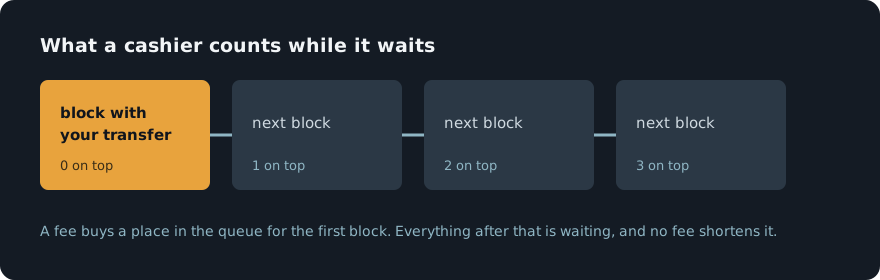
Paying generously improves the odds of getting into the next block. It does nothing about what comes after. A cashier that waits for a handful of confirmations is waiting for blocks to be produced, and no payment makes them arrive sooner.
This is the distinction worth carrying away: a fee buys priority in a queue, not speed in a clock. A reader who pays the top rate and then watches a balance sit for half an hour has not been cheated, and nothing has gone wrong.
The number of confirmations a cashier requires is its own decision and is worth reading before the first transfer rather than during it.
Bitcoin and Bitcoin-Lightning are two lines, not one
BitStarz's payments page lists 'Bitcoin' and 'Bitcoin - Lightning' as two separate payment types, one under the other, and shows the same 0% fee against each. That 0% is what the page says the operator charges. It is not a statement about what the network takes on the way, and it is the only place among the twelve operators where a second Bitcoin route is named by the operator itself.
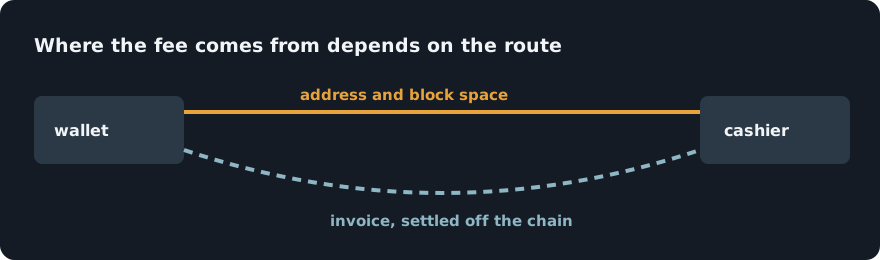
The two routes differ in what the sender pastes and in what the sender waits for. An on-chain deposit goes to an address and waits for blocks, and its fee is the payment for room in one. A Lightning deposit is made against an invoice, a payment request that carries its own amount and an expiry time, and it travels over a chain of payment channels between nodes instead of being written into a block for each payment.
So the cost is different in kind. Nodes along the route can take a very small routing fee, which a wallet normally shows before the payment is sent, and there is no confirmation count to wait for: the payment completes or it fails. A wallet has to support Lightning to use the second line at all, and an invoice that has expired cannot be paid, so the wallet is best opened while the cashier still shows the invoice.
The practical rule is to name the route before quoting a number. A figure for the on-chain line says nothing about the Lightning line, and the reverse, and this page gives no time or cost for either as BitStarz's own.
What BitStarz's payments page leaves out
The page lists Bitcoin among the currencies accepted, plus the two Bitcoin lines above. For the on-chain line it names no network beyond the word Bitcoin and no confirmation count, so no waiting time is attributed to BitStarz here.
It also prints minimum and maximum amounts per transaction for its payment types. They are not repeated: they change, the cashier screen shows the current ones, and a number printed here would be the first to go stale.
No bonus, licence or rating is stated for BitStarz on this page.
Other cashiers read the same way

Cloudbet
What the wallet quotes and what the cashier credits are two readings of the same transfer.

CoinCasino
On a payout the fee is either taken out of the sum or added beside it, and the difference is yours.

Duelbits
Economy, normal and priority are guesses about the next few blocks, not promises.
Questions this page gets
- Does sending twice as much cost twice as much?
- No. The price follows the size of the instruction in data, so moving a larger sum usually costs about the same as moving a smaller one on the same day.
- Why was the fee different an hour later?
- Because the queue changed. The price is set by how many instructions are competing for the next blocks, and that number moves continuously.
- Can paying more speed up confirmations?
- It improves the chance of being in the next block. After that the wait is simply blocks being produced, and no payment shortens it.
- Does a deposit minimum apply before or after the fee?
- A cashier credits what arrives, so read the minimum against the amount after the deduction rather than the amount typed into the wallet.