BTC at Vave: What a Confirmation Count Measures
This page is about the cashier: how a Bitcoin amount arrives in an account, what the transfer paid for, and the interval before the balance can be used. It makes no judgement about the operator and carries no score.
Its subject is the second half of that interval, the part readers blame on the wrong party. A fee buys a place in the first block. Everything after that is blocks being produced on a schedule nobody at either end controls, and it is free.

Waiting for blockchain confirmations
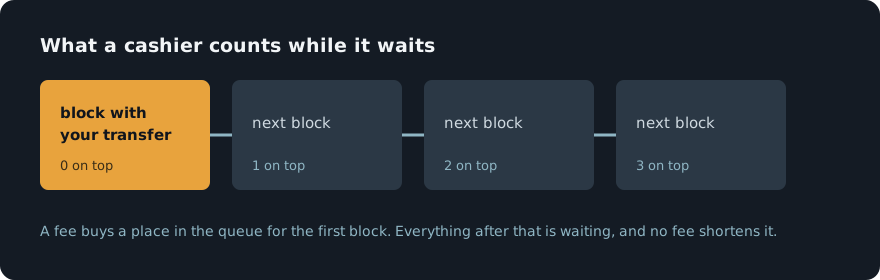
A confirmation is a block built on top of the one carrying your instruction. One confirmation means a block has been added since; three means three have. A cashier choosing how many to wait for is choosing how much settlement it wants before it moves a balance.
The count exists because a very recent block is the one most likely to be reorganised. Waiting makes that progressively less likely, which is why a cashier handling a large arrival may reasonably wait longer than one handling a small one.
None of this is purchasable. The fee bought a place in a queue, and the queue ended the moment the instruction was included. After that the reader is waiting on arithmetic.
How long is a reasonable wait
Blocks are produced at an average rate, not a fixed one, so the honest answer is a distribution rather than a number. A run of quick blocks and a long gap are both ordinary, and a single slow interval is not evidence of anything.
This is why a cashier that promises an exact crediting time is promising something it does not control, and why a cashier that states a confirmation count instead is being more useful. One is a guess about the chain; the other is a statement about its own policy.
A reader who needs a balance at a particular moment should allow for the slow case rather than the median, and send earlier rather than paying more.
Where the balance unit enters the picture
Whether an account stays denominated in Bitcoin or is converted internally decides whether the credited figure can be compared with the sent figure at all. If a conversion happened, the two numbers are in different units and the comparison needs the rate the cashier used.
That is worth establishing before the first transfer, because it also governs how stakes, balances and payout limits read later. A consistently labelled account is one whose history can be reconciled; an inconsistently labelled one is not.
It has nothing to do with the fee, which was paid on the chain in the coin before the cashier saw anything at all.
What Vave's help centre lists, and what it does not settle
Vave's help article on accepted cryptocurrencies answers in one line that begins with BTC and runs through ETH, BCH, DOGE, USDT with three networks spelled out, LTC, TRX and XRP, plus two fiat currencies. By its own update stamp the article is several years old, which is a reason to confirm anything on it in the cashier.
Bitcoin is on that list with no network named. The only coin with networks written out is USDT. Vave's separate table of minimum deposits groups BTC and BCH under one figure, which shows how loosely coin labels can be written in a cashier: a figure given for a group is not a figure for one coin, and the amounts are not repeated here.
Neither article states a fee, a confirmation count or a crediting time, so none is attributed to Vave. No bonus, licence or limit is stated here.
Other cashiers read the same way

BC.GAME
Three separate charges can land on one deposit. Only one of them belongs to the chain.

BetFury
An exchange withdrawal charge and a network fee are different animals, and both can bite the same transfer.

BitStarz
Two Bitcoin lines on one payments page: the chain, and Lightning, which is settled another way.
Questions this page gets
- What does three confirmations mean?
- That three blocks have been added on top of the one carrying the instruction. The count measures settlement depth, not speed.
- Can I pay to confirm faster?
- Only for the first block. Confirmations after that are blocks being produced on their own schedule, and no payment changes it.
- Why do some cashiers wait longer?
- Because a very recent block is the one most likely to be reorganised, and a larger arrival is worth more settlement before a balance moves.
- Is a slow interval a problem?
- Not by itself. Blocks arrive at an average rate rather than a fixed one, so a long gap and a quick run are both ordinary.