BTC at Stake: the Fee Is Set by the Sending Side
This page is about one end of an account: the part where a Bitcoin amount leaves a wallet, travels as an instruction to the chain, and turns up as a balance. It follows the fee that journey pays, the confirmations a cashier waits for, and the two figures that have to be compared once the balance moves. It is not a verdict on Stake and carries no score, because no score has been measured.
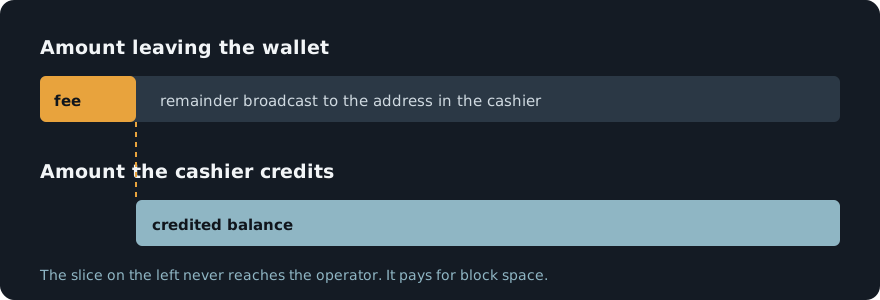
The practical point is that the operator does not choose the fee. Whatever is shown on a deposit screen, the amount handed to the chain is decided in the wallet or at the exchange the transfer starts from, and the balance that appears is what is left after that deduction. Everything below is written so the arithmetic is predictable before the transfer is sent rather than explained afterwards.

What is the bitcoin network fee, and who decides it
A Bitcoin transfer is an instruction competing with other instructions for room in the next block. Room is finite, so each instruction offers a payment for it, and the offer is attached by whoever signs the transfer. That is the sending wallet or the exchange account the coins are leaving, never the receiving cashier.
This is why two people sending the same amount on the same day can pay very different fees. The sum being moved is almost irrelevant to the price; what matters is how much competition there is for the next few blocks and how generous the sender decided to be.
A deposit screen can display an estimate, and a good one does. It cannot overrule the figure the sending side attached, and it cannot refund it either, because the payment never belonged to the operator in the first place.
Do you have to pay a fee to receive money from Bitcoin
Receiving costs nothing. Nobody charges for an arrival, and a cashier that credits a deposit is not taking a cut of the chain's work. The confusion usually comes from the other direction: the amount that arrives is smaller than the amount that was typed, and the gap looks like a receiving charge.
It is not. The gap is the payment the sender's wallet attached before broadcasting, and some wallets quote the total including it while others quote the sum net of it. Reading which convention a wallet uses is the whole of the arithmetic.
A withdrawal reverses the roles. Then the operator is the sending side, it attaches the payment, and the figure you receive depends on whether it was taken out of the requested sum or charged beside it. That is a question for the payout screen, and it is covered on the note about payout records.
Reading the deposit screen before you confirm
The useful habit is to write down two numbers before anything is signed: the figure the wallet says will leave the account, and the minimum the cashier says it needs. If the first minus the fee lands under the second, the transfer can arrive and still fail to credit automatically, and the fix is a support conversation rather than a second transfer.
Keep the transaction reference the wallet produces. It is the only way to tell a slow block from an account problem, and it is the first thing a support desk asks for. A reference costs nothing to save and is impossible to reconstruct later.
Treat the address on the screen as single-use unless the cashier says otherwise. An address copied out of an old message may still belong to the operator and may no longer belong to your account, which produces a transfer that confirmed perfectly and credited nobody.
What Stake's help centre says about Bitcoin
Stake's own help article on acceptable blockchain networks lists Bitcoin against a single network, written there as 'Bitcoin (native network)'. That is the Bitcoin chain itself, so the fee described above is the ordinary on-chain fee, and the table offers no second network to choose between for this coin.
The same article carries a general warning in the operator's words: 'It's important that you send coins through their corresponding blockchain networks.' It prints no fee figure, no confirmation count and no crediting time for Bitcoin, so none is attributed to Stake here. The fee that comes out of a deposit is still the one the sending side attached.
Stake's main site refused an automated read, so only the help centre was read. No minimum, limit, bonus or licence is stated for Stake on this page; the cashier screen carries the current figures.
Other cashiers read the same way

Vave
Once a transfer is in a block, waiting for more confirmations costs nothing and buys nothing.

BC.GAME
Three separate charges can land on one deposit. Only one of them belongs to the chain.

BetFury
An exchange withdrawal charge and a network fee are different animals, and both can bite the same transfer.
Questions this page gets
- Can an operator lower the network fee on a deposit?
- No. The payment is attached by the wallet or exchange the transfer leaves from, and it is spent before the instruction reaches anyone else. A cashier can show an estimate and nothing more.
- Why did my balance come out lower than the amount I typed?
- Because some wallets quote the sum before the fee and deduct it afterwards. The difference is what paid for room in a block, and it never reached the operator.
- Does a larger transfer cost more to send?
- Not meaningfully. The price follows the size of the instruction and how busy the chain is, so a large sum and a small one can cost almost the same to move.
- Is 18 the age this site is written for?
- Yes. These pages are written for adults of 18 or older, which is the age the legacy pages stated, and no page here is addressed to anyone younger.