BTC Withdrawal Records: Three Figures Make One Auditable
On a payout the roles reverse. The operator becomes the sending side, so it attaches the payment for block space and decides whether that payment comes out of the requested sum or sits beside it. This note is about reading the record afterwards and working out which happened.
Three figures do it: the sum requested, the sum handed to the chain, and the sum that landed. Where a record shows all three, any gap explains itself. Where it shows only a status, the reader is guessing.

The two conventions, and which one you met
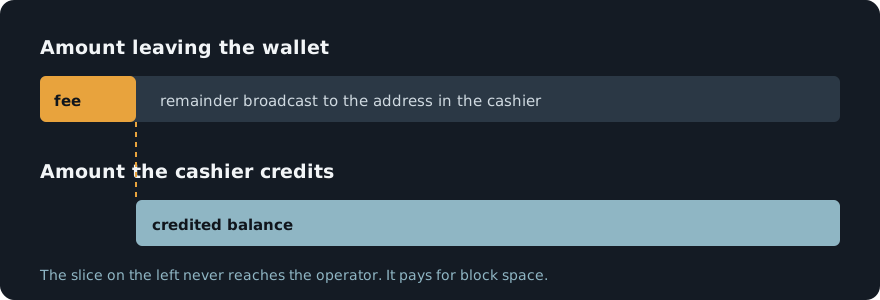
If the payment was taken out of the requested sum, the request and the arrival differ by exactly the fee, and a reader expecting a round figure sees a shortfall. If it was charged beside the sum, the arrival matches the request and a little extra left the balance.
Both are ordinary. What makes the difference painful is a payout screen that does not state which applies, leaving the convention to be deduced from a figure that turned up an hour later.
The deduction is straightforward with the record in front of you: compare the requested sum to the arrival, then compare the requested sum to the balance movement. Whichever pair differs by the fee tells you the convention.
Whose wait are you in
Before a transaction reference exists, the request has not been broadcast and the wait belongs to the operator: review, approval, internal processing, whatever its own stages are. Nothing about the chain is relevant yet.
Once a reference exists, the wait belongs to the chain, and it consists of inclusion in a block followed by however many confirmations the destination wants. Neither side controls the pace, and no payment shortens the second part.
Separating the two is the difference between a complaint that makes sense and one that does not. A reader who asks an operator why the chain is slow is asking the wrong party, and a reader who waits patiently for a reference that was never created is waiting for nothing.
What a record should contain
The amount, the unit, the time the request was created, its current state, and the reference once there is one. Five fields, none of them expensive, and together they make every subsequent question answerable without a conversation.
Rejected and pending requests should stay in the history rather than disappearing. A history that is complete only when everything worked is a history that fails precisely when it is needed.
On the reader's side, keep the reference until the destination wallet shows the arrival settled. A request marked complete on one side and absent on the other is almost always a wait, and the reference is what proves it.
Why the shape of a balance changes the cost
An instruction has to name every earlier arrival it spends. A balance assembled from a dozen small deposits produces a larger instruction than the same total that arrived once, and room in a block is sold by data, so the larger instruction costs more.
That cost is the operator's to pay on a payout, which is exactly why the convention above matters: under one convention it lands on your arrival, under the other on your balance.
The lever a reader has is blunt and real. Fewer, larger movements in both directions cost less in total than many small ones, and nothing about that is anybody's policy.
Other cashiers read the same way

Stake
The sending side chooses the fee. A cashier can display it and cannot set it.

CoinCasino
On a payout the fee is either taken out of the sum or added beside it, and the difference is yours.

Cloudbet
What the wallet quotes and what the cashier credits are two readings of the same transfer.
Questions about reading a payout record
- Why did I receive less than I requested?
- Most likely the payment for block space was taken out of the requested sum. The other convention charges it beside the sum and the arrival matches the request.
- There is no reference yet. Is something wrong?
- Not necessarily. Before a reference exists the request has not been broadcast, so the wait is the operator's internal one rather than the chain's.
- Can the payout fee be reduced?
- Not by the person requesting it. The sending side attaches the payment, and on a payout that is the operator.
- Does the number of past deposits affect a payout?
- Indirectly. An instruction spending many earlier arrivals is larger in data terms and costs more to send, whoever is paying for it.