BTC Deposit Checklist: Settle Four Figures Before Signing
The arithmetic of a Bitcoin deposit is simple and it has to be done in the right order. This note is the order: four figures, settled in the sending account before anything is signed, after which the balance that appears can be explained without consulting anybody.
It is not a list of warnings about addresses and networks, which other notes cover. It is specifically about money: what leaves, what the chain takes, what arrives, and what the cashier does with what arrived.

The four figures, in order
First, the sum you intend to move. Second, the payment the sending wallet will attach for room in a block, which on some interfaces is a separate line and on others is folded into a total. Third, any price the sending platform charges for releasing the coins, which is its own revenue and appears on its own screen.
Fourth, the figure the cashier says it needs. That last one is compared against the first minus the second and third, not against the first, because a cashier credits what arrives and nothing else.
Written down, the four take under a minute and remove every subsequent surprise. Reconstructed afterwards from memory they are almost impossible to recover, because the quote that produced them is gone.
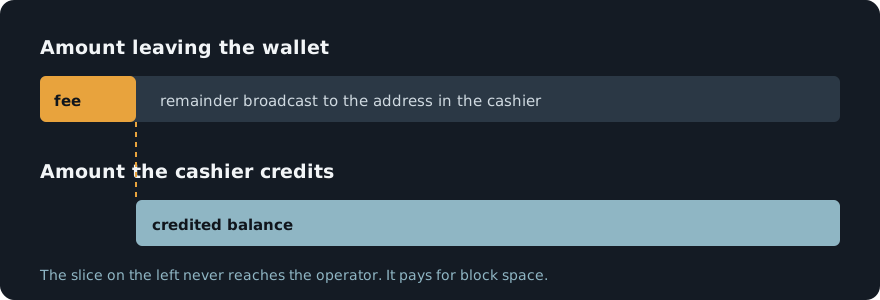
Where each figure is actually displayed
Figure one is the only one a reader types, which is why it is the only one anybody remembers. Figure two tends to sit under an expandable summary, particularly on a phone, and defaults to whatever preset the wallet last used rather than to a considered choice.
Figure three is on a different screen in a different session, which is why it is the one most often missed entirely. A platform that releases coins on your behalf is selling a service and prices it in a document nobody reads before a first transfer.
Figure four is on the cashier screen, usually next to the payment route rather than at the top, and it frequently differs between routes offered under the same ticker. Reading the figure beside the route is the habit worth forming.
The margin worth adding
If the comparison lands close to the minimum, raising the transfer slightly is cheaper than finding out later. An arrival below a stated minimum can fall outside the automatic crediting rule, and the resolution is a conversation measured in hours rather than a second transfer.
A second transfer in that situation is the wrong instinct twice over: it pays a second fee, and it does not combine with the first for the purpose of a minimum unless the cashier says it does.
Where the margin is wide, none of this is worth thinking about. The point of the checklist is to tell the two cases apart before signing rather than after.
What to keep once it is sent
The transaction reference, until the balance has moved. It is the only artefact that distinguishes a slow block from an account problem, it is the first thing a support desk asks for, and it cannot be reconstructed from an account screen.
The two figures from the wallet, until the credited amount has been compared against them. A gap of the usual size is the fee; a gap several times larger points at the sending platform rather than at the cashier.
Nothing else is worth retaining. The address was single-use, the preset is irrelevant once the instruction is broadcast, and the quote has already been superseded by what the chain actually did.
Other cashiers read the same way

Duelbits
Economy, normal and priority are guesses about the next few blocks, not promises.

FortuneJack
A fixed charge hurts a small transfer and barely scratches a large one.

Rollbit
A transfer sent too cheaply sits unconfirmed, and the way out is a replacement, not a retry.
Questions about the order of these checks
- Why compare the minimum against the delivered amount?
- Because a cashier credits what arrives. The payment for block space was taken before arrival, so the typed figure is not the one its rule applies to.
- What if I am slightly under the minimum?
- The arrival may fall outside the automatic rule and need a conversation. A second transfer pays a second fee and usually does not combine with the first.
- Which figure is hardest to find?
- The sending platform's own price, because it lives on a different screen in a different session from the deposit.
- How long should I keep the reference?
- Until the balance has moved. It is the only thing that separates a slow block from an account problem, and it cannot be recovered later.