BTC Bonus Balances and the Deposit That Falls Just Short
An offer that did not trigger on a deposit that looked large enough is usually one thing: the amount that arrived was smaller than the amount that was sent, and the offer was measured against the arrival. This note is about that gap and the two balances it affects.
No offer figure appears here for any operator, because none of them could be confirmed from the operator's own cashier. What can be described is the mechanism, which applies to whatever figure a cashier happens to use.

Qualifying is measured on arrival
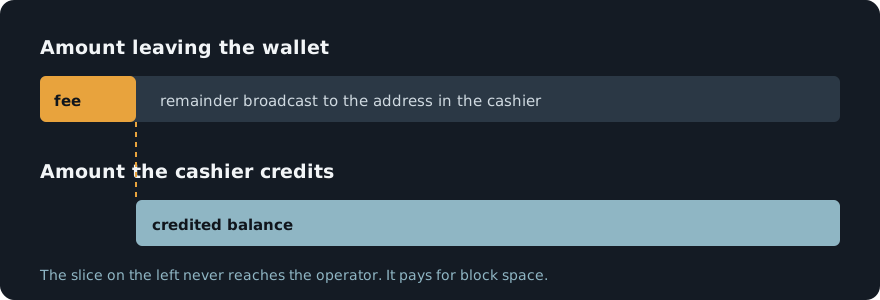
A cashier credits what the chain delivered. An offer requiring a minimum deposit is attached to that credited figure, and the difference from the sent figure went to block space before the cashier saw anything.
On a transfer comfortably above the threshold the point is academic. On one sized exactly to the threshold it decides the outcome, and the reader is left certain that something was withheld when in fact nothing was.
A minimum stated in the coin and a minimum stated as a fiat equivalent behave differently here, because only one of them is fixed in the unit the fee is paid in. Where a cashier offers both presentations, the one it applies is the one that counts.
Two balances, one visible total
While an offer is live, most cashiers hold an account as two pools: funds that can be moved and funds held until a condition is met. The figure on screen is frequently the sum of both, which is why a payout request can be refused on an account that looks well funded.
A cashier that labels the two separately saves a great deal of confusion. One that shows a single number and reveals the split only at the payout step is accurate and misleading at the same time.
On a Bitcoin account the unit compounds it. If the balance is converted internally, the split is tracked in the converted unit, and reconciling it against a transfer measured in the coin requires the rate the cashier used and the moment it was fixed.
Reading the conditions before the money moves
The useful question is not how large an offer is but whether its release condition is reachable. What has to be staked, which parts of the lobby count and at what rate, what the ceiling on converted winnings is, and when it expires: four answers that together decide whether the headline figure means anything.
Those answers belong on a screen reachable before a deposit. Where they appear only afterwards, the offer cannot be assessed, and that is itself a finding worth acting on.
The last question is a cashier one: whether a live offer restricts moving the balance. It decides whether the money is yours while the condition is outstanding, which is the only question that matters at the end.
A short habit covers most of it: before sending, write down the amount that will actually arrive once the fee is out, and read every condition against that figure rather than against the number typed into the wallet. The two can differ by enough to put a transfer on the wrong side of a line, and the only moment to find out cheaply is before the transfer is signed.
Why this note quotes nobody
Because none of the twelve operators this site carries published an offer figure in the material it is built from. That was checked rather than assumed, and the honest record is a gap instead of a number that reads convincingly.
Figures from comparison sites are not a substitute. They disagree with one another, they age badly, and a term quoted out of its own context is wrong in the way that costs a reader money rather than merely misinforming them.
So the conditions have to be read where they are published. This note can name the questions and refuse to invent the answers.
Other cashiers read the same way

FortuneJack
A fixed charge hurts a small transfer and barely scratches a large one.

BetFury
An exchange withdrawal charge and a network fee are different animals, and both can bite the same transfer.

BitStarz
Two Bitcoin lines on one payments page: the chain, and Lightning, which is settled another way.
Questions about offers and the amount that arrives
- My deposit was above the minimum but the offer did not trigger.
- Compare the credited figure rather than the sent one. The payment for block space was taken before arrival, and the offer is measured on arrival.
- Will a second deposit top it up to the threshold?
- Only if the cashier says it combines arrivals for that purpose. Many do not, and the second transfer pays its own fee regardless.
- Why can I not withdraw a balance I can see?
- Because the visible total often includes funds held until a release condition is met. A cashier that labels the two pools separately avoids the confusion.
- Are there offer figures anywhere on this site?
- No. None of the operators here published one, and borrowing a figure from a comparison table would be a fabrication.